
Search results: "Cydia" 24 IDaids
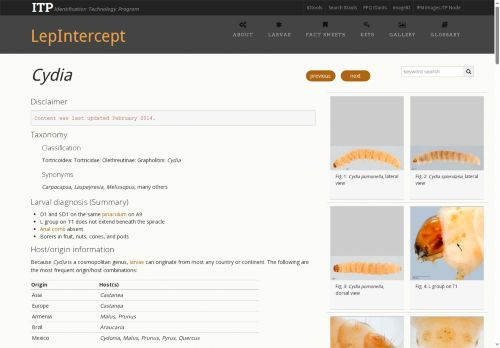
LepIntercept: An Identification Resource for Intercepted Lepidoptera Larvae: Cydia
Screening Aid/Fact Sheet/Pest Alert
United States Department of Agriculture (USDA)
This fact sheet for the genus Cydia is from the fact sheet collection in LepIntercept, a USDA APHIS PPQ ITP tool . It features high-quality photos of larvae you can enlarge to see character details. Four tabs offer both an overview and detailed information, as well as “Interception Records” and a “Setal Map.” Select “Keys” from the top menu to use a Lucid key to 41 intercepted larvae, or choose from a set of dichotomous keys for advanced users.
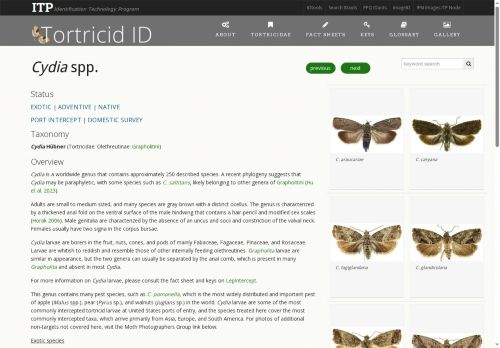
TortAI – Tortricids of Agricultural Importance: Cydia
Screening Aid/Fact Sheet/Pest Alert
United States Department of Agriculture (USDA)
This fact sheet for the genus Cydia is one of 125 in TortAI, a USDA APHIS PPQ ITP tool . It provides an overview of genus morphology and describes other important charcteristics, and acknowledges the CAPS status of noteworthy target and non-target species within the genus. Select “KEYS” in the top menu to use either an adult key covering CAPS survey taxa, or a larval key covering port intercepted taxa.
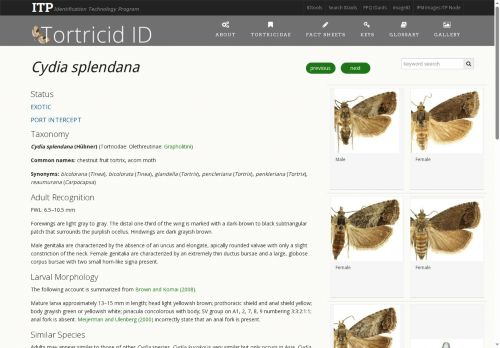
TortAI – Tortricids of Agricultural Importance: Cydia splendana
Screening Aid/Fact Sheet/Pest Alert
United States Department of Agriculture (USDA)
This fact sheet for Cydia splendana, the chestnut fruit tortrix (aka acorn moth), is one of 125 in TortAI, a USDA APHIS PPQ ITP tool . It describes adult recognition and larval morphology and features the tortricid’s CAPS status. Select “KEYS” in the top menu to use either an adult key covering CAPS survey taxa, or a larval key covering port intercepted taxa.
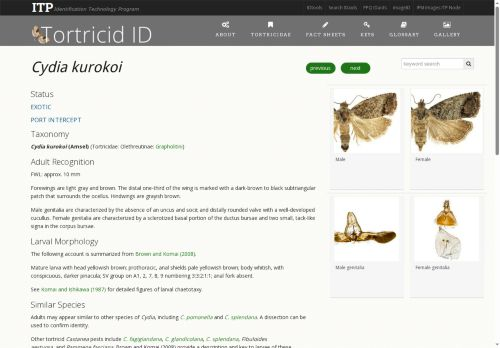
TortAI – Tortricids of Agricultural Importance: Cydia kurokoi
Screening Aid/Fact Sheet/Pest Alert
United States Department of Agriculture (USDA)
This fact sheet for Cydia kurokoi is one of 125 in TortAI, a USDA APHIS PPQ ITP tool . It describes adult recognition and larval morphology and features the tortricid’s CAPS status. Select “KEYS” in the top menu to use either an adult key covering CAPS survey taxa, or a larval key covering port intercepted taxa.
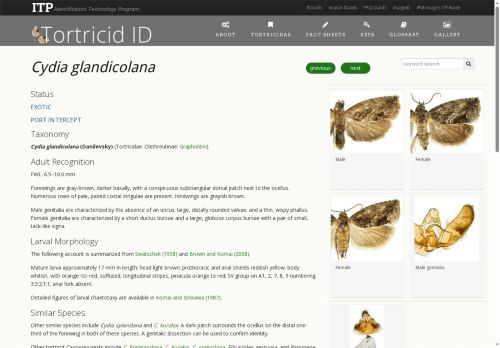
TortAI – Tortricids of Agricultural Importance: Cydia glandicolana
Screening Aid/Fact Sheet/Pest Alert
United States Department of Agriculture (USDA)
This fact sheet for Cydia glandicolana is one of 125 in TortAI, a USDA APHIS PPQ ITP tool . It describes adult recognition and larval morphology and features the tortricid’s CAPS status. Select “KEYS” in the top menu to use either an adult key covering CAPS survey taxa, or a larval key covering port intercepted taxa.
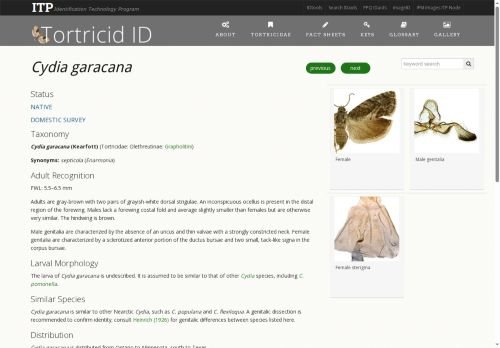
TortAI – Tortricids of Agricultural Importance: Cydia garacana
Screening Aid/Fact Sheet/Pest Alert
United States Department of Agriculture (USDA)
This fact sheet for Cydia garacana is one of 125 in TortAI, a USDA APHIS PPQ ITP tool . It describes adult recognition and larval morphology and features the tortricid’s CAPS status. Select “KEYS” in the top menu to use either an adult key covering CAPS survey taxa, or a larval key covering port intercepted taxa.
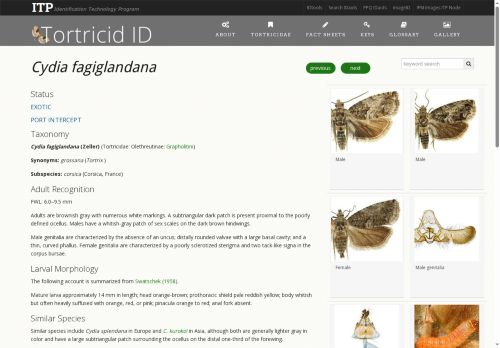
TortAI – Tortricids of Agricultural Importance: Cydia fagiglandana
Screening Aid/Fact Sheet/Pest Alert
United States Department of Agriculture (USDA)
This fact sheet for Cydia fagiglandana is one of 125 in TortAI, a USDA APHIS PPQ ITP tool . It describes adult recognition and larval morphology and features the tortricid’s CAPS status. Select “KEYS” in the top menu to use either an adult key covering CAPS survey taxa, or a larval key covering port intercepted taxa.
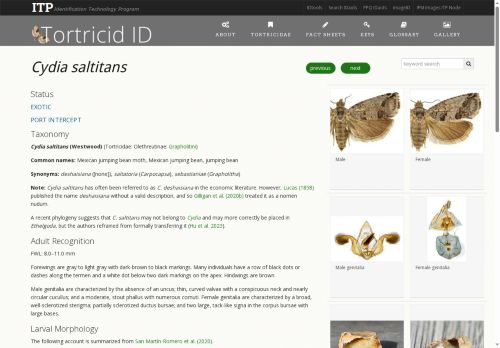
TortAI – Tortricids of Agricultural Importance: Cydia saltitans
Screening Aid/Fact Sheet/Pest Alert
United States Department of Agriculture (USDA)
This fact sheet for Cydia saltitans, the Mexican jumping bean moth, is one of 125 in TortAI, a USDA APHIS PPQ ITP tool . It describes adult recognition and larval morphology and features the tortricid’s CAPS status. Select “KEYS” in the top menu to use either an adult key covering CAPS survey taxa, or a larval key covering port intercepted taxa.
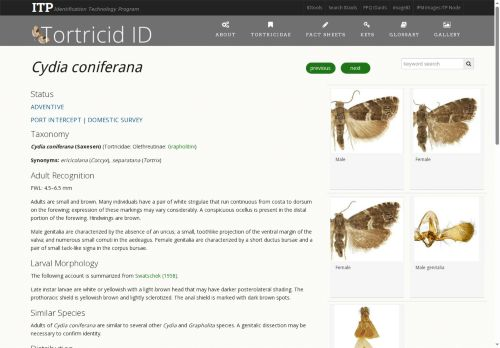
TortAI – Tortricids of Agricultural Importance: Cydia coniferana
Screening Aid/Fact Sheet/Pest Alert
United States Department of Agriculture (USDA)
This fact sheet for Cydia coniferana is one of 125 in TortAI, a USDA APHIS PPQ ITP tool . It describes adult recognition and larval morphology and features the tortricid’s CAPS status. Select “KEYS” in the top menu to use either an adult key covering CAPS survey taxa, or a larval key covering port intercepted taxa.
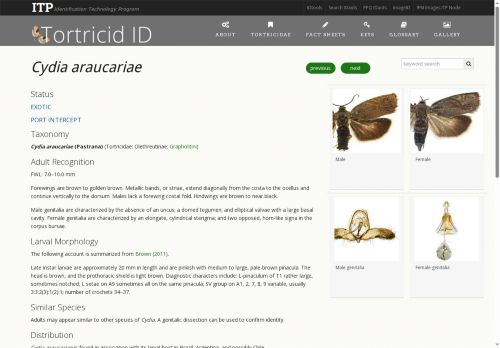
TortAI – Tortricids of Agricultural Importance: Cydia araucariae
Screening Aid/Fact Sheet/Pest Alert
United States Department of Agriculture (USDA)
This fact sheet for Cydia araucariae is one of 125 in TortAI, a USDA APHIS PPQ ITP tool . It describes adult recognition and larval morphology and features the tortricid’s CAPS status. Select “KEYS” in the top menu to use either an adult key covering CAPS survey taxa, or a larval key covering port intercepted taxa.
Guide to the Olethreutine moths of midland North America (Tortricidae)
Key
Miller WE. 1987. Guide to the Olethreutine moths of midland North America (Tortricidae). USDA Forest Service Agriculture Handbook 660. 110 pp.
Key to the genera of Olethreutine moths occurring in the Central States of the U.S. Has black and white images of the wing patterns and line drawings of diagnostic parts of the male and female genitalia.
Paralobesia (syn. Endopiza).
Paralobesia (syn. Endopiza).
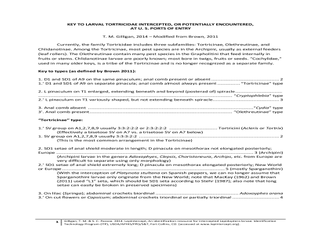
Key to larval Tortricidae intercepted, or potentially encountered at U.S. ports of entry
Key
Gilligan TM. 2014. Key to larval Tortricidae intercepted, or potentially encountered at U.S. ports of entry. 5 pp. In: Gilligan TM and Passoa SC. LepIntercept, An identification resource for intercepted Lepidoptera larvae. USDA-APHIS-PPQ-S&T Identification Technology Program (ITP)
Modified from Brown, 2011. Currently, the family Tortricidae includes three subfamilies: Tortricinae, Olethreutinae, and Chlidanotinae. Among the Tortricinae, most pest species are in the Archipini, usually as external feeders (leaf rollers). The Olethreutinae contain many pest species in the Grapholitini that feed internally in fruits or stems. Chlidanotinae larvae are poorly known; most bore in twigs, fruits or seeds. “Cochylidae,” used in many older keys, is a tribe (Cochylini) of the Tortricinae and is no longer recognized as a separate family. Developed with LepIntercept identification tool, a USDA APHIS PPQ ITP tool.
Tortricid ID: Cydia nigricana
Screening Aid/Fact Sheet/Pest Alert
United States Department of Agriculture (USDA)
This fact sheet for Cydia nigricana (pea moth), is one of 214 in Tortricid ID, a USDA APHIS PPQ S&T ITP tool . It describes adult recognition and larval morphology and includes similar species, distribution information, and a searchable plant association table. Use the top menu items to find supporting information such as interactive identification keys to both adults and larva, dissection guides, an illustrated glossary, a searchable and filterable plant association table for all taxa, and an image gallery.
CABI Compendium: Grapholita funebrana (red plum maggot)
Screening Aid/Fact Sheet/Pest Alert
CABI
Abstract: This datasheet on Grapholita funebrana covers Identity, Overview, Distribution, Dispersal, Hosts/Species Affected, Diagnosis, Biology and Ecology, Natural Enemies, Impacts, Prevention/Control, Further Information.
Records with other specific names seem to be due to misidentification. Other names associated with this taxon include: (scientific names) Carpocapsa funebrana, Cydia funebrana; (common names) plum fruit moth, prune moth, and gusano de las ciruelas.
LepIntercept: An Identification Resource for Intercepted Lepidoptera Larvae: Cydia splendana
Screening Aid/Fact Sheet/Pest Alert
United States Department of Agriculture (USDA)
This fact sheet for Cydia splendana (chestnut fruit tortrix or acorn moth) is from the fact sheet collection in LepIntercept, a USDA APHIS PPQ ITP tool . It features high-quality photos of larvae you can enlarge to see character details. Four tabs offer both an overview and detailed information, as well as “Interception Records” and a “Setal Map.” Select “Keys” from the top menu to use a Lucid key to 41 intercepted larvae, or choose from a set of dichotomous keys for advanced users.
LepIntercept: An Identification Resource for Intercepted Lepidoptera Larvae: Cydia pomonella
Screening Aid/Fact Sheet/Pest Alert
United States Department of Agriculture (USDA)
This fact sheet for Cydia pomonella (codling moth) is from the fact sheet collection in LepIntercept, a USDA APHIS PPQ ITP tool . It features high-quality photos of larvae you can enlarge to see character details. Four tabs offer both an overview and detailed information, as well as “Interception Records” and a “Setal Map.” Select “Keys” from the top menu to use a Lucid key to 41 intercepted larvae, or choose from a set of dichotomous keys for advanced users.
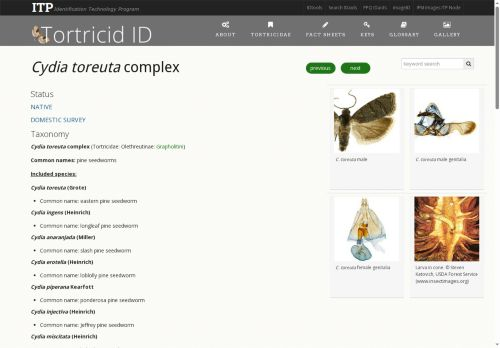
TortAI – Tortricids of Agricultural Importance: Cydia toreuta complex
Screening Aid/Fact Sheet/Pest Alert
United States Department of Agriculture (USDA)
This fact sheet for Cydia toreuta complex, pine seedworms, is one of 125 in TortAI, a USDA APHIS PPQ ITP tool . It describes adult recognition and larval morphology and features the tortricid’s CAPS status. Select “KEYS” in the top menu to use either an adult key covering CAPS survey taxa, or a larval key covering port intercepted taxa.
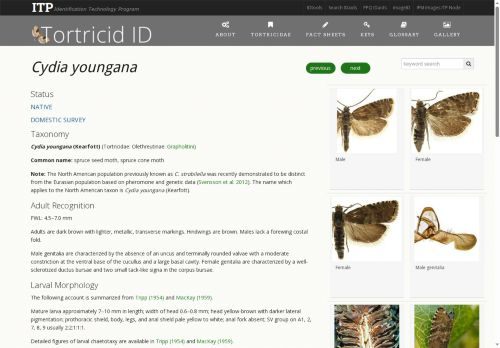
TortAI – Tortricids of Agricultural Importance: Cydia youngana
Screening Aid/Fact Sheet/Pest Alert
United States Department of Agriculture (USDA)
This fact sheet for Cydia youngana is one of 125 in TortAI, a USDA APHIS PPQ ITP tool . It describes adult recognition and larval morphology and features the tortricid’s CAPS status. Select “KEYS” in the top menu to use either an adult key covering CAPS survey taxa, or a larval key covering port intercepted taxa.
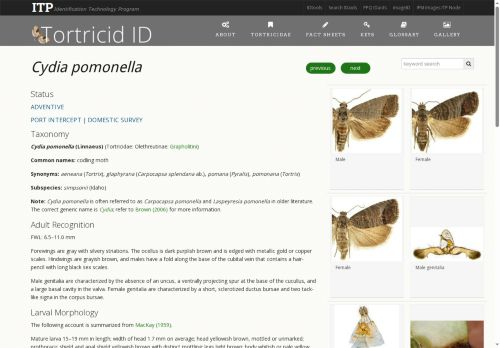
TortAI – Tortricids of Agricultural Importance: Cydia pomonella
Screening Aid/Fact Sheet/Pest Alert
United States Department of Agriculture (USDA)
This fact sheet for Cydia pomonella, the codling moth, is one of 125 in TortAI, a USDA APHIS PPQ ITP tool . It describes adult recognition and larval morphology and features the tortricid’s CAPS status. Select “KEYS” in the top menu to use either an adult key covering CAPS survey taxa, or a larval key covering port intercepted taxa.
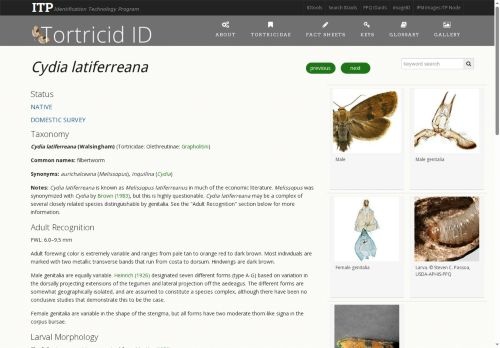
TortAI – Tortricids of Agricultural Importance: Cydia latiferreana
Screening Aid/Fact Sheet/Pest Alert
United States Department of Agriculture (USDA)
This fact sheet for Cydia latiferreana, the filbertworm, is one of 125 in TortAI, a USDA APHIS PPQ ITP tool . It describes adult recognition and larval morphology and features the tortricid’s CAPS status. Select “KEYS” in the top menu to use either an adult key covering CAPS survey taxa, or a larval key covering port intercepted taxa.
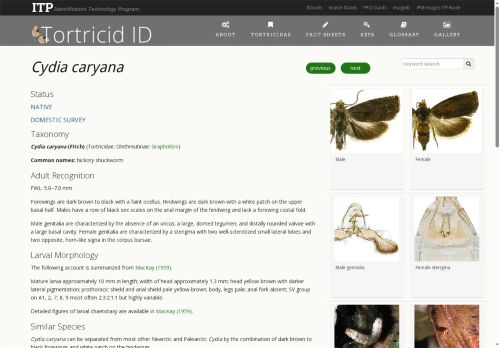
TortAI – Tortricids of Agricultural Importance: Cydia caryana
Screening Aid/Fact Sheet/Pest Alert
United States Department of Agriculture (USDA)
This fact sheet for Cydia caryana, the hickory shuckworm, is one of 125 in TortAI, a USDA APHIS PPQ ITP tool . It describes adult recognition and larval morphology and features the tortricid’s CAPS status. Select “KEYS” in the top menu to use either an adult key covering CAPS survey taxa, or a larval key covering port intercepted taxa.

Pecan Pest Management: Insects and Diseases
Fact Sheet Collection
University of Missouri, United States of America
This website includes information and images for the pecan nut casebearer (Acrobasis nuxvorella), the hickory shuckworm (Cydia caryana), the nut curculio (Conotrachelus hicoriae), the pecan weevil (Curculio caryae), pecan phylloxera (Phylloxera devastatrix) and pecan scab (Cladosporium caryigenum).
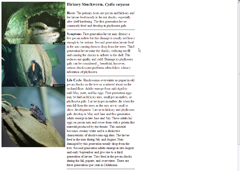
Hickory Shuckworm, Cydia caryana
Screening Aid/Fact Sheet/Pest Alert
Oklahoma State University, United States of America
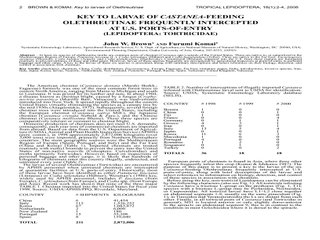
Key to larvae of Castanea-feeding Olethreutinae frequently intercepted at U.S. ports-of-entry (Lepidoptera: Tortricidae)
Key, Taxonomic Description, Host-Based Search or Focus, Journal Article, PPQ Inspection Aid
Brown JW and Komai F. 2008. Key to larvae of Castanea-feeding Olethreutinae frequently intercepted at U.S. ports-of-entry (Lepidoptera: Tortricidae). Tropical Lepidoptera 18 (1): 2-4.
Abstract: At least six species of olethreutine moths are common pests of chestnut (Castanea spp.) outside of the United States. Three are native to, or naturalized in the Mediterranean Region of Europe: Pammene fasciana (L.), Cydia splendana (Hübner) and Cydia fagiglandana (Zeller). Three are native to the Far East: Eucoenogenes aestuosa (Meyrick), Cydia kurokoi (Amsel), and Cydia glandicolana (Danilevsky). Commercial chestnuts imported into the U.S. from these regions are fumigated routinely to prevent entrance of these and other pests. However, larvae of these species frequently are encountered by agricultural inspectors at ports-of-entry in personal baggage and other cargo. A key to the larvae of these six species is presented, along with summary descriptions and select references on their biology, detection, and control in association with chestnuts.
This paper includes a key to larvae of six Tortricid moths that feed on chestnuts and are frequently intercepted as U.S. ports-of-entry, along with diagrams and descriptions.