Prosopis strombulifera (Lamarck) Bentham
Strombocarpa strombulifera (Lam.) A. Gray
Prosopis strombulifera (Lam.) Benth.
Fabaceae
Mimosoideae
Only ten seeds of Strombocarpa strombulifera were available for examination. Therefore, the description and images in this fact sheet may not be representative of this species’ seeds.
Argentine screwbean
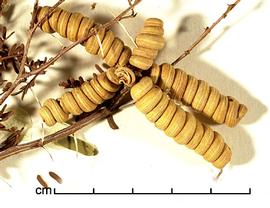
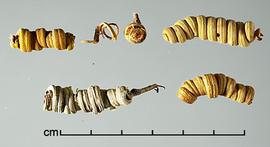
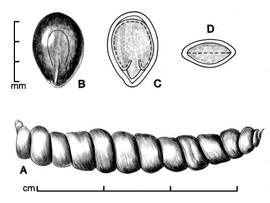
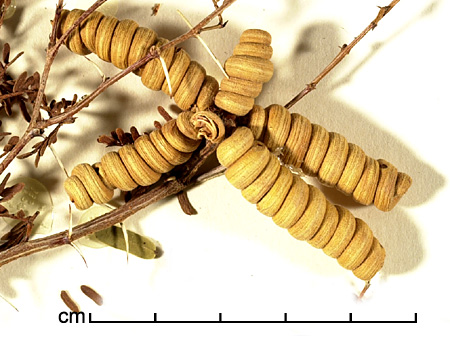
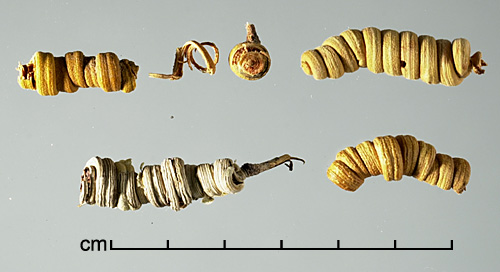
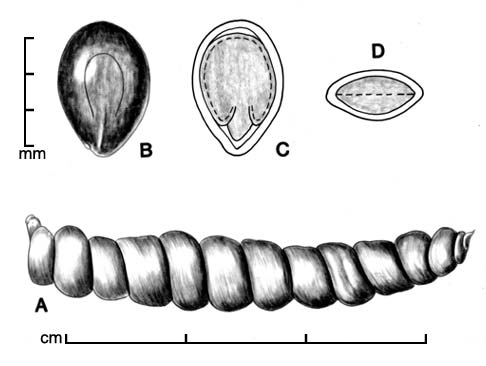
Pods tightly coiled (like a corkscrew) into a cylinder with 8–17 coils each 3–5 mm thick, cylinder straight or slightly curved, 1.5–5.2 cm long, 6–10 mm in diameter. Margins nonundulate. Puberulous when young, lemon-yellow when ripe, veins obscure; seed chambers not visible. Mesocarp pulpy, tannic, reddish; endocarp easily disintegrates. Seeds oriented longitudinally.
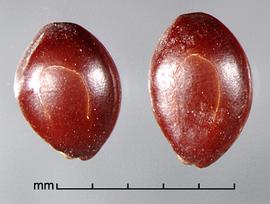
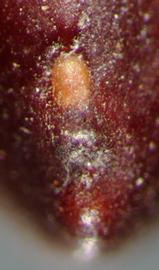
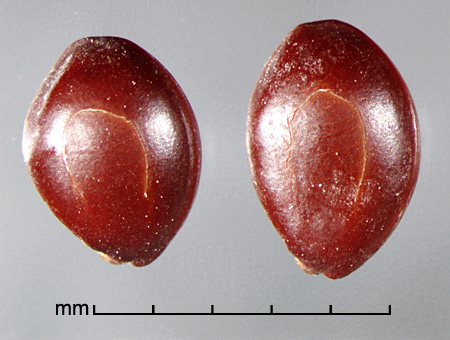
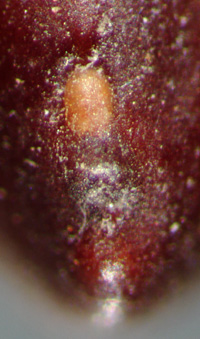
Seeds usually obovate in outline, (3.1)4.2–5.5 mm long, 2.2–4 mm wide, 1–2 mm thick, umbo absent, elliptic in cross section. Pleurogram average in size. Lens a mound.
Pods of:
Strombocarpa reptans (Pods have 9–19 coils.)
Prosopis reptans var. cinerascens (Gray) Burkart (Pods have 9–12 coils.) (non-FNW)
Prosopis pubescens Benth. (Pods have 8–24 coils, puberulous or almost glabrous.) (non-FNW)
native to Argentina, Chile, Peru; also found in the United States
arid and semi-arid regions, sandy, rocky soils, disturbed places below 50 m
Strombocarpa strombulifera is a spiny shrub up to 3 m tall. This species often forms dense stands, reproducing vegetatively by long, spreading lateral roots from which new shoots develop. Accidentally introduced to California as an experimental desert rangeland plant. Some infestations in the Sonoran Desert have been eradicated. In Chile, the pods are used as a remedy for toothache, and the roots contain a brown dye used for tanning. The seeds are tightly held, but are dispersed by livestock that eat the sweet pods.
Authors: J.L. Scher, D. S. Walters, and A.J. Redford
Edition 2.2 - April 2015; Nomenclature last updated Feb 2026
Lucid mobile app for Android and iOS | tool images at ITP Node
idtools.org