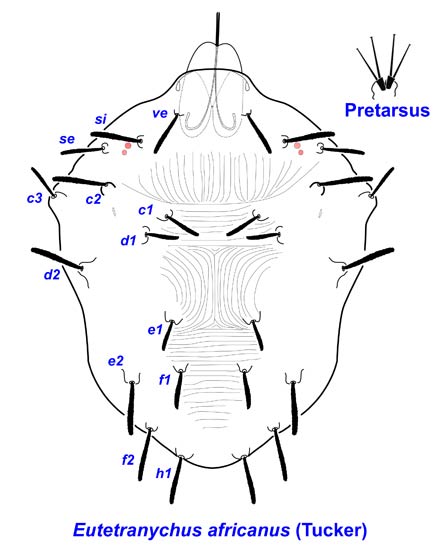
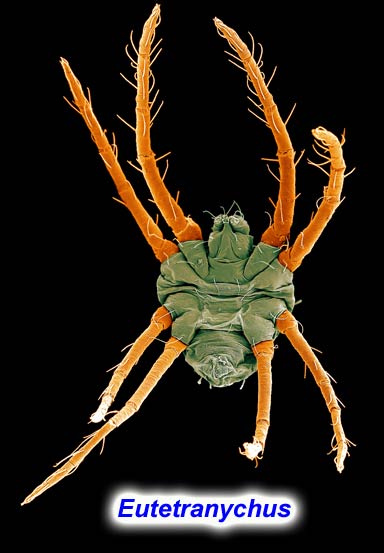
Tetranychinae
t
Taxonomy
Classification
updated 2025
Superorder Acariformes » Order Trombidiformes » Suborder Prostigmata » Infraorder EleutherengonaEleutherengona:
(also Eleutherengonida, Eleutherengonina, Eleutherengonides) an infraorderwithin the Prostigmata consisting of the two hyporders Raphignathina and Heterostigmata. Eleutherengona includes many of the most important plant-parasitic mites, e.g., spider mites, broad mite, cyclamen mite.
» Hyporder Raphignathina » Superfamily Tetranychoidea » Family Tetranychidae » Subfamily Tetranychinae » Tribe Eutetranychini » Genus Eutetranychus
Common names
Oriental mite, Oriental red mite, African mite, African red mite, Texas citrus mite
Probability of encounter
high
Quarantine importance
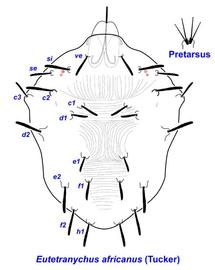
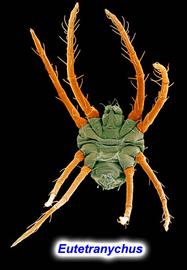
Very high. More than 30 species of Eutetranychus have been described, mostly oligophagus species of little economic interest, but several polyphagous species are major pests in parts of the world. The main polyphagous pests tend to be morphologically variable and may represent species complexes; authors vary on the number of 'species' recognized or synonymized.
- African mite—Eutetranychus africanus (Tucker) (=E. sambiranensis Gutierrez & Helle 1971) is an important pest of citrus and attacks a wide variety of other crops including apple, peach, grape, guava, papaya, cotton, eggplant, and a variety of ornamentals. The African mite is widely distributed in Africa and also occurs in India, Southeast Asia, Papua New Guinea, and islands in the Indian Ocean.
- Texas citrus mite—Eutetranychus banksi McGregor (=E. rusti McGregor, E. clarki McGregor, E. mexicanus McGregor) is an important pest of citrus and attacks a wide variety of other crops, ornamentals, and native plants. It is established throughout the warmer parts of North, South, and Central America, including the U.S.
- Oriental red mite—Eutetranychus orientalis (Klein) (=E. monodi Andre, E. sudanicus El Badry, E. anneckei Meyer, Anychus orientalis Klein, A. ricini Rahman & Sapra) is probably the most important pest species in the genus and attacks the greatest known diversity of plants (ca. 200 species). It is an important pest of citrus in many parts of the world, but only a sporadic minor pest in Australia. The Oriental mite is also a pest on many types of fruit trees (e.g., apple, avocado, apricot, peach, plum), grape, blackberry, bananas, walnut, ornamentals, melon, sugarcane, maize, sorghum, eggplant, pepper, sweet potato, cassava, beans, etc. The Oriental mite is established in much of Asia including Japan and the Philippines, and widely distributed in Africa, the Middle East, and Turkey, and present in Cyprus, the Cape Verde Islands, and eastern Australia. It is apparently not yet established in the Americas or Europe.
Diagnosis
- With 2 pairs of anal setaeseta:
(pl. setae, from L. = bristle) cuticular process composed of a hollow shaft (sometimes filled with a refractive material) produced from a membranous socket (the alveolus); the hair-like, spine-like, branched or variously expanded structures on the surfaces of the legs and body. Most setae function as mechanoreceptors, but others (e.g., solenidia) are chemoreceptors or have unknown or ambiguous functions.
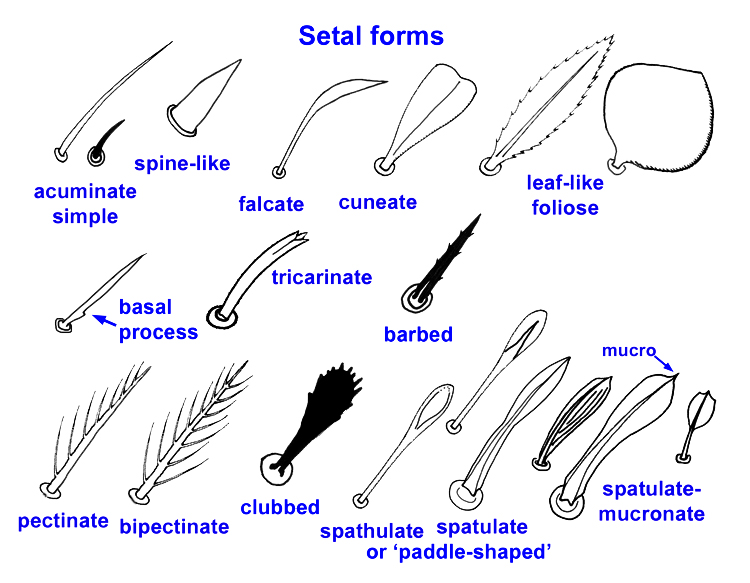 (ps1–2)
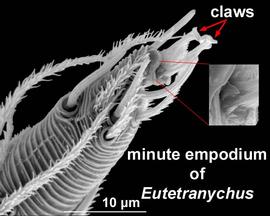
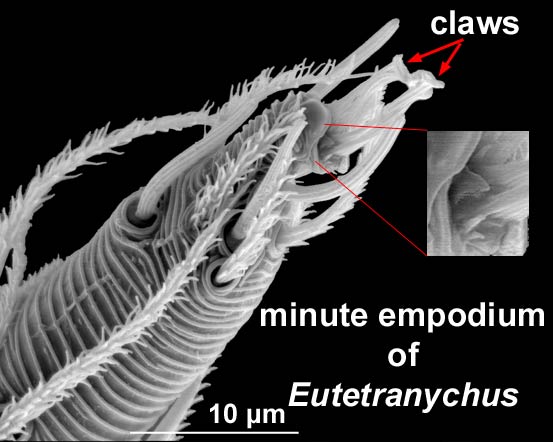
- Empodial claw minute, appearing absent
- Tarsustarsus:
(pl. tarsi) the subdistal leg segment between the tibia and the pretarsus (apotele).
I lacking 2 distinct pairs of duplex setaeseta:
(pl. setae, from L. = bristle) cuticular process composed of a hollow shaft (sometimes filled with a refractive material) produced from a membranous socket (the alveolus); the hair-like, spine-like, branched or variously expanded structures on the surfaces of the legs and body. Most setae function as mechanoreceptors, but others (e.g., solenidia) are chemoreceptors or have unknown or ambiguous functions.
- Opisthosomaopisthosoma:
(= abdomen) the posterior body division in arachnids; usually not distinct in mites because of the fusion of the opisthosoma with part of the prosoma to form the idiosoma.
with 10 pairs of dorsal setaeseta:
(pl. setae, from L. = bristle) cuticular process composed of a hollow shaft (sometimes filled with a refractive material) produced from a membranous socket (the alveolus); the hair-like, spine-like, branched or variously expanded structures on the surfaces of the legs and body. Most setae function as mechanoreceptors, but others (e.g., solenidia) are chemoreceptors or have unknown or ambiguous functions.
Similar taxa
The empodia are distinct and have tenent hairs in the Bryobiinae and are well developed in the Tetranychini. Species of Aponychus have 1 pair of anal setae.
References
- Baker and Pritchard 1960Baker and Pritchard 1960:
Baker EW, Pritchard AE. 1960. The tetranychoid mites of Africa. Hilgardia 29 (11): 455–574.
- Baker and Tuttle 1994Baker and Tuttle 1994:
Baker EW, Tuttle DM. 1994. A guide to the spider mites (Tetranychidae) of the United States. Indira Publishing House, West Bloomfield, Michigan. 347 pp.
- Beard et al. 2003Beard et al. 2003:
Beard JJ, Walter DE, Allsopp P. 2003. Spider mites of sugarcane in Australia: A review of grass-feeding Oligonychus Berlese (Acari: Prostigmata: Tetranychidae) with the description of four new species. Australian Journal of Entomology 42: 51–78.
- Bolland et al. 1998Bolland et al. 1998:
Bolland HR, Gutierrez J, Flechtmann CHW. 1998. World catalogue of the spider mite family (Acari: Tetranychidae). Brill, Leiden.
- Helle and Sabelis 1985Helle and Sabelis 1985:
Helle W and Sabelis MW, eds. 1985. Spider mites: Their biology, natural enemies, and control. World Crop Pests, Vol. 1A. Elsevier, New York.
- Jeppson et al. 1975Jeppson et al. 1975:
Jeppson LR, Keifer HH, Baker EW. 1975. Mites injurious to economic plants. University of California Press, Berkeley.
- Meyer 1974Meyer 1974:
Meyer MKPS. 1974. A revision of the Tetranychidae of Africa (Acari) with a key to the genera of the world. Republic of South Africa, Department of Agricultural Technical Services, Entomology Memoir No. 36: 291 pp.
- Meyer 1987Meyer 1987:
Meyer MKPS. 1987. African Tetranychidae (Acari: Prostigmata) - with reference to the world genera. Republic of South Africa, Department of Agriculture and Water Supply, Entomology Memoir No. 69: 175 pp.
- Migeon and Flechtmann 2004Migeon and Flechtmann 2004:
Migeon A, Flechtmann CHW. 2004. First additions and corrections to the World Catalogue of the Spider Mite Family (Acari: Tetranychidae). International Journal of Acarology 30 (2): 143–152.
- Navajas et al. 1997Navajas et al. 1997:
Navajas M, Gutierrez J, Gotoh T. 1997. Convergence of molecular and morphological data reveals phylogenetic information in Tetranychus species and allows the restoration of the genus Amphitetranychus (Acari: Tetranychidae). Bulletin of Entomological Research 87: 283–288.
- Ochoa et al. 1994Ochoa et al. 1994:
Ochoa R, Aguilar H, Vargas C. 1994. Phytophagous mites of Central America: An illustrated guide. CATIE, Turrialba, Costa Rica.
- Tseng 1990Tseng 1990:
Tseng Y-H. 1990. A monograph of the mite family Tetranychidae (Acarina: Trombidiformes) from Taiwan. Taiwan Museum Special Publication Series 9. 224 pp.
- Walter et al. 1995Walter et al. 1995:
Walter DE, Halliday RB, Smith D. 1995. The oriental red mite Eutetranychus orientalis (Klein) (Acariformes: Tetranychidae) in Australia. Journal of the Australian Entomological Society 34: 307–308.
- Zhang 2003Zhang 2003:
Zhang Z-Q. 2003. Mites of greenhouses: Identification, biology and control. CABI Publishing, Wallingford. 244 pp.