test
Opilioacarida Zakhvatkin, 1952
Superorder Parasitiformes » Order Opilioacarida
superfamily: Opilioacaroidea
opilioacarans, opilioacarids
very low
None. These mites are rare and of no known quarantine importance.
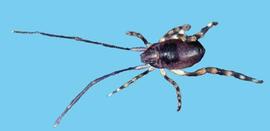
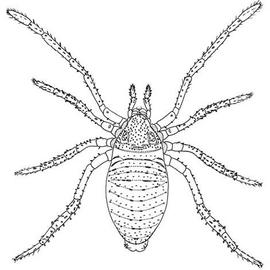
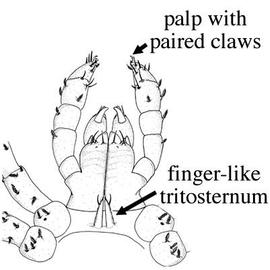
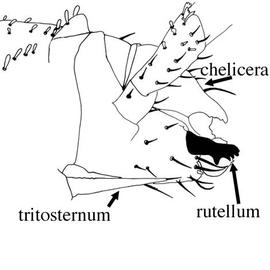
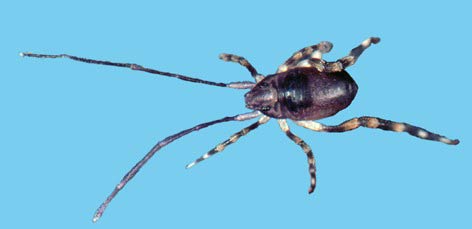
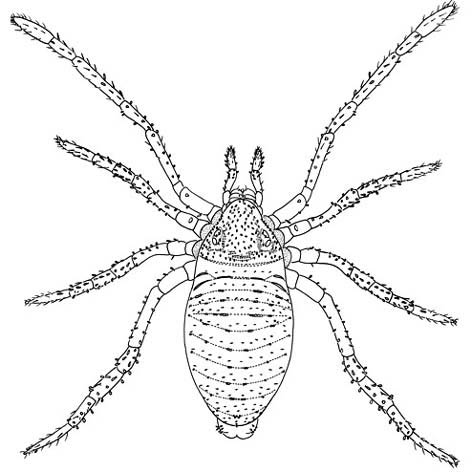
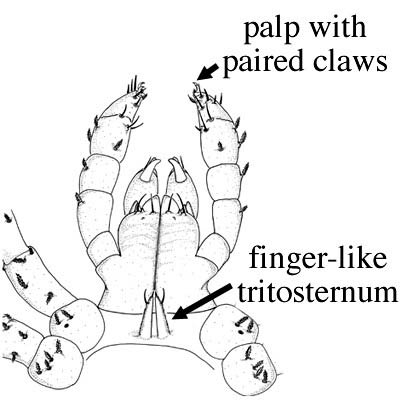
Primitive mites related to the Parasitiformes and resembling small opilionids. Soft-bodied, grey-blue to lilac in colour, usually with white bands or stripes. Peritremes absent; opisthosomaopisthosoma:
(= abdomen) the posterior body division in arachnids; usually not distinct in mites because of the fusion of the opisthosoma with part of the prosoma to form the idiosoma.
bearing four pairs of dorso-lateral spiracles (adults and tritonymphs); prosomaprosoma:
(= cephalothorax) the anterior body region in arachnids; usually not distinct in mites.
with 2–3 pairs of lateral ocelliocellus:
(pl. ocelli) a simple eye. Mites with eyes usually have one or two pairs of lateral ocelli, but some Opilioacarida have three pairs. Additionally, some acariform mites have one or two median ocelli on the underside of the naso.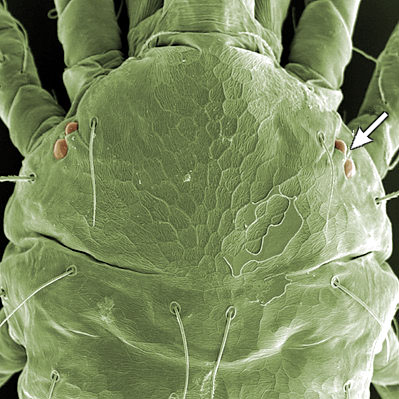 ; gnathosomagnathosoma:
(= capitulum) the anteriormost part of a mite or ricinuleid, composed of the cheliceral and pedipalpal segments and separated from the body (idiosoma) by a ring of soft cuticle.
bearing >4 pairs of ventral setaeseta:
(pl. setae, from L. = bristle) cuticular process composed of a hollow shaft (sometimes filled with a refractive material) produced from a membranous socket (the alveolus); the hair-like, spine-like, branched or variously expanded structures on the surfaces of the legs and body. Most setae function as mechanoreceptors, but others (e.g., solenidia) are chemoreceptors or have unknown or ambiguous functions.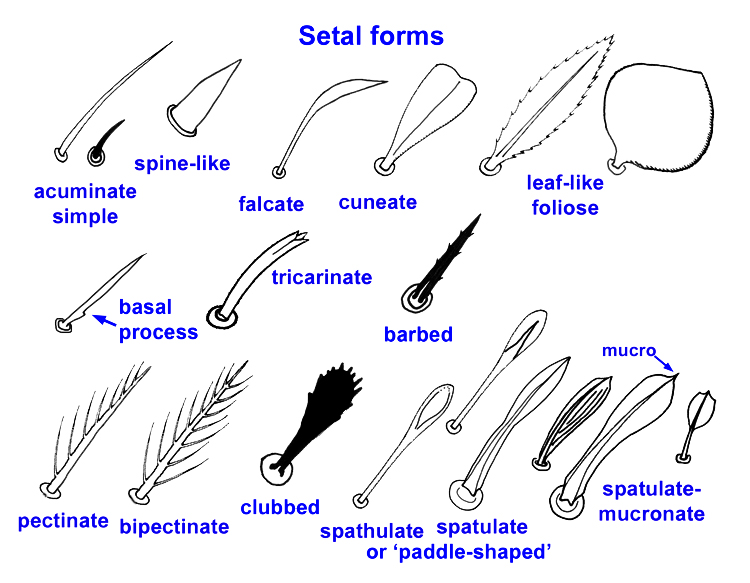 , rutellarutellum:
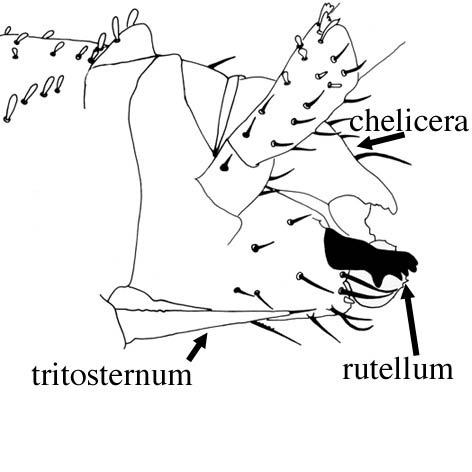
(pl. rutella) In Sarcoptiformes, the hypertrophied setae on the hypostome, often toothed; not to be confused with a corniculus (although possibly a homologue). In Astigmata, the rutellum may be referred to as a pseudorutellum, although it is the same structure. Various forms of rutella are recognized, including the atelebasic and pantelebasic.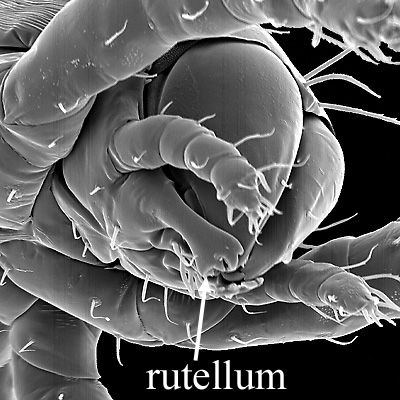 and With’s organ; chelicerae 3-segmented, with 3–5 setaeseta:
(pl. setae, from L. = bristle) cuticular process composed of a hollow shaft (sometimes filled with a refractive material) produced from a membranous socket (the alveolus); the hair-like, spine-like, branched or variously expanded structures on the surfaces of the legs and body. Most setae function as mechanoreceptors, but others (e.g., solenidia) are chemoreceptors or have unknown or ambiguous functions. and 2 lyrifissures on middle article; palps with 5 segments and well developed clawclaw:
like - having a distal hook; resembling a claw.
; tritosternumtritosternum:
the sternum of the 3rd body segment (between legs I); produced as a biflagellate structure in Mesostigmata, although sometimes the flagellae (laciniae) are partially or completely fused. 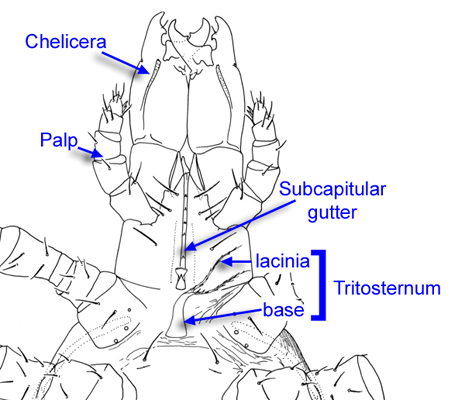 unfused, with finger-like processes; coxae free; trochanters III and IV divided; all pedal tarsitarsus:
(pl. tarsi) the subdistal leg segment between the tibia and the pretarsus (apotele).
divided.
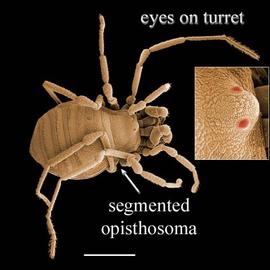
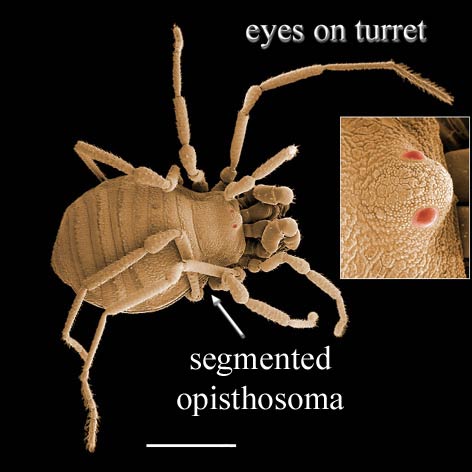
Opilionida (harvestmen) which have segmented opisthosomas and eyes (when present) on a median turret, and Eupodidae (Prostigmata), which have 2-segmented chelicerae, genital papillaegenital papillae:
1-3 pairs of extrusible finger-like to button-like projections, usually retracted into in the genital vestibule of acariform mites; sometimes formed as sessile disks around the genital opening; thought to be osmoregulatory structures; modified or multiplied and dispersed over the body in many freshwater mites. Genital papillae are absent in the larva, but may be added ontogenetically: protonymphs have one pair, deutonymphs two pairs, and tritonymphs (and adults) three pairs. The tritonymphal pair of papillae is often lost. The serially homologous Claparède's organ is usually present in the larvae (and prelarvae) of mites exhibiting genital papillae in nymphs and adults (Oudeman's Rule).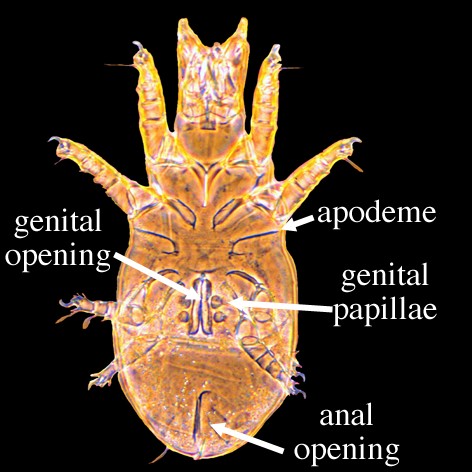 , and often have swollen femorafemur:
(pl. femora) major leg segment between trochanter and genu; often subdivided into a basifemur and a telofemur.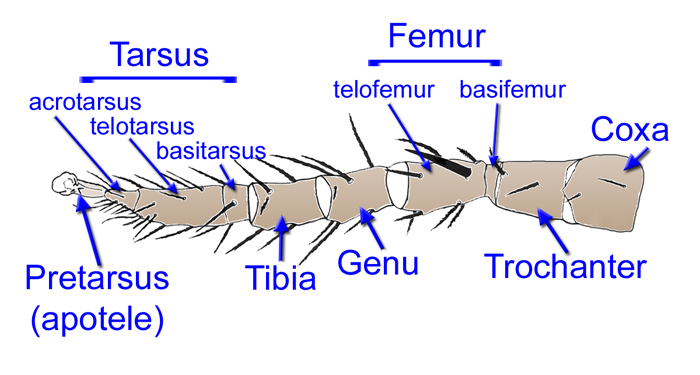 IV for jumping. The only known Australian representative of the group is currently undescribed, but has been collected in the Kimberleys, Kakadu, and Far North Queensland.
Predators and scavengers in Mediterranean and tropical habitats including rainforest litter and caves. Australian opilioacarans can be found under rocks in mesic gullies in dry, tropical habitats. Adults are less than 3 mm in length, purplish brown with white striped legs, fast moving, and feed on pollen, fungi, and small arthropods.
Author: David E. Walter
Content last updated Sept. 2006, unless indicated otherwise
Lucid key player updated Sept. 2025
idtools.org