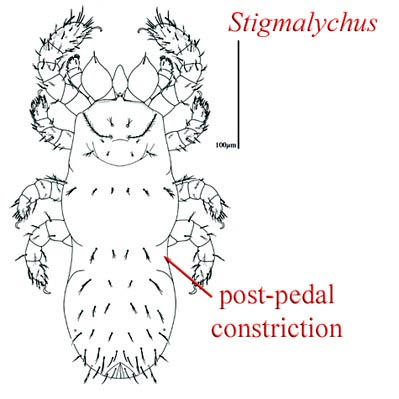
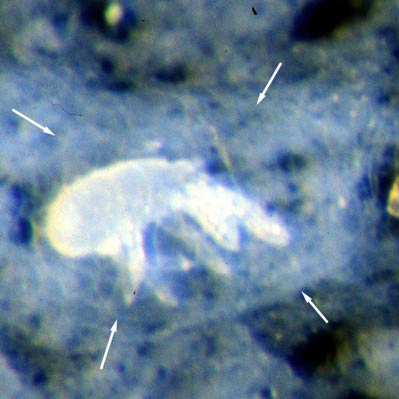
test
EndeostigmataEndeostigmata:
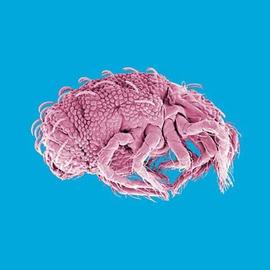
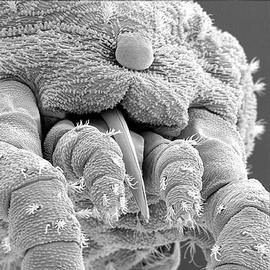
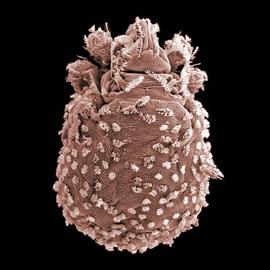
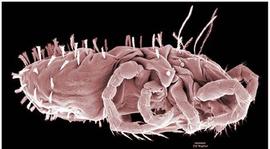
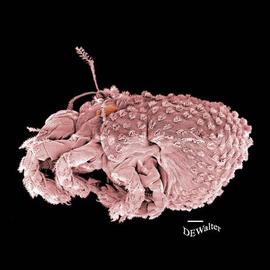
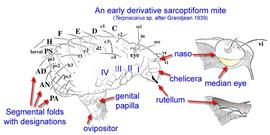
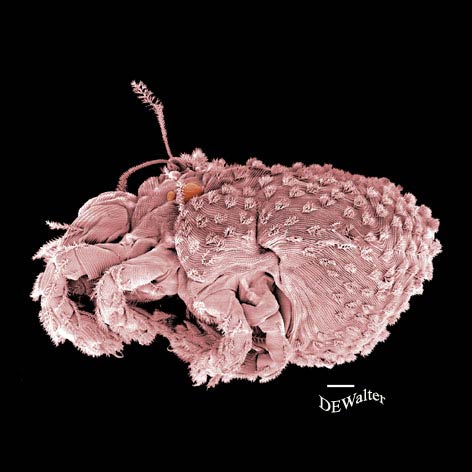
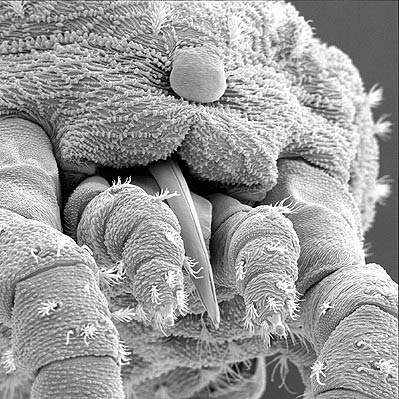
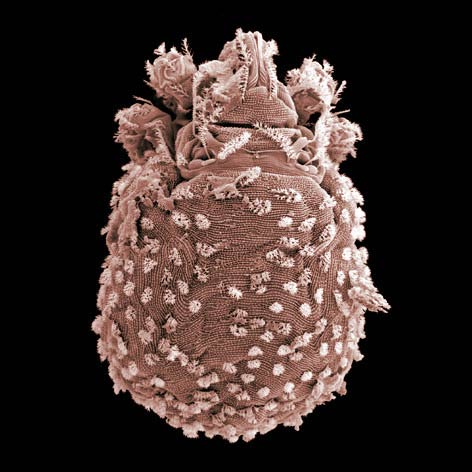
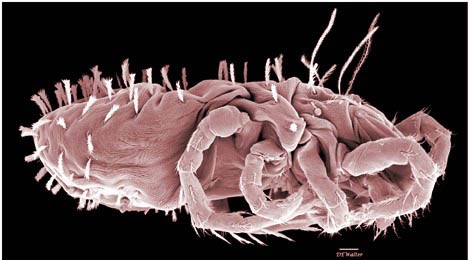
a paraphyletic assemblage of early derivative sarcoptiform mites that has often been misplaced in the Prostigmata. Ten families are currently recognized, including the widespread and common Nanorchestidae, Bimichaeliidae, Alicorhagiidae, and Terpnacaridae. Most endeostigmatans are fungivores, algivores or feed on minute, soft-bodied invertebrates such as nematodes.
Reuter, 1909
Superorder Acariformes » Order Sarcoptiformes » Suborder EndeostigmataEndeostigmata:
a paraphyletic assemblage of early derivative sarcoptiform mites that has often been misplaced in the Prostigmata. Ten families are currently recognized, including the widespread and common Nanorchestidae, Bimichaeliidae, Alicorhagiidae, and Terpnacaridae. Most endeostigmatans are fungivores, algivores or feed on minute, soft-bodied invertebrates such as nematodes.
infraorders: Alicorhagiida, Bimichaliida, Nematalycina, Terpnacarida
endeostigmatans
medium
None. Most endeostigmatans are rare and all that have been studied are fungivores, algivores or predators of small invertebrates. Many species appear to be ancient thelytokousthelytokous:
exhibiting all female parthenogenesis (thelytoky).
lineages with cosmopolitan distributions.
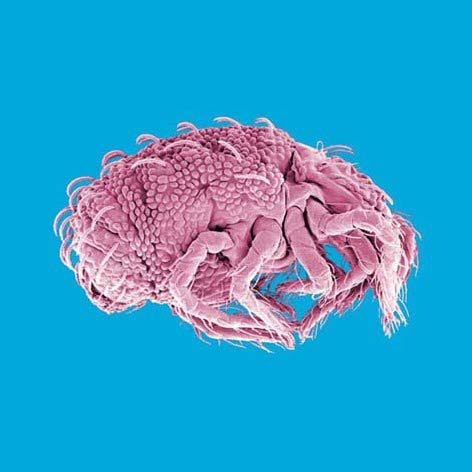
Soft-bodied, sometimes hypertrichous, acariform mites, often with remnants of primary segmentation. Bodybody:
the idiosoma of mites.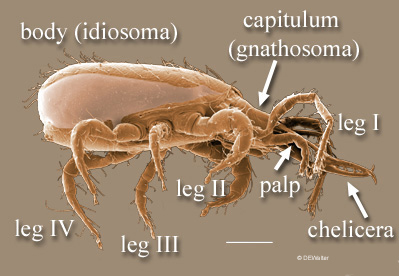 cuticle usually plicateplicate:
with a pattern of raised, narrowly aligned ridges like a fingerprint; used to describe the soft cuticle of many mites.
, sometimes with secondary ornamentation; colorless (white) to pale lilac, bright pink or yellowish brown. Prodorsumprodorsum:
the dorsal surface of the propodosoma.
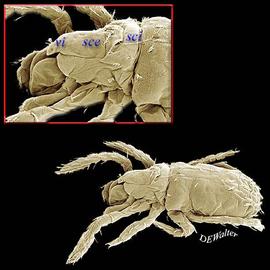
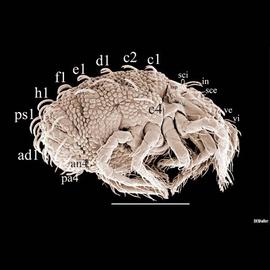
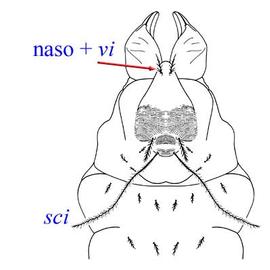
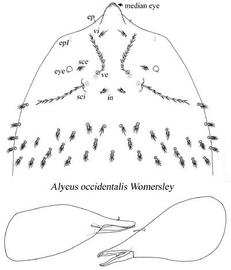
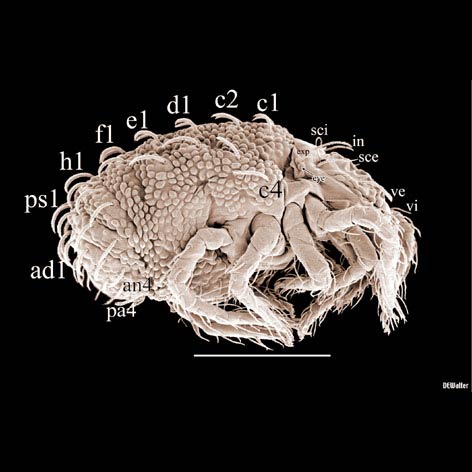
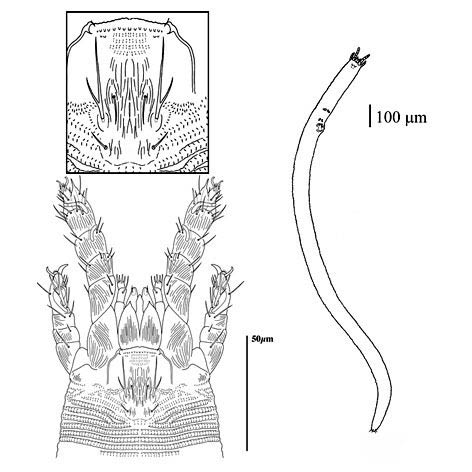
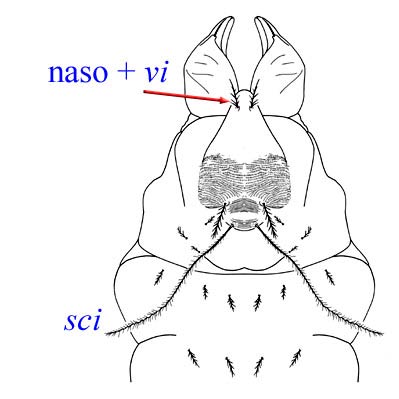
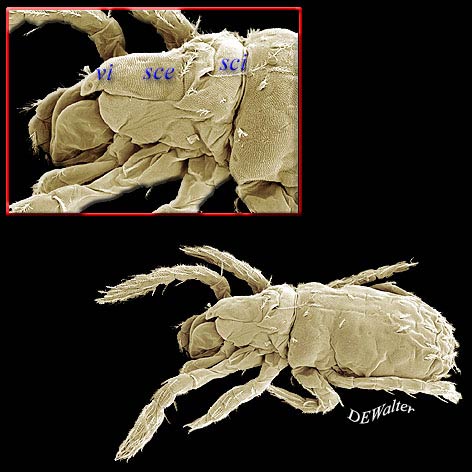
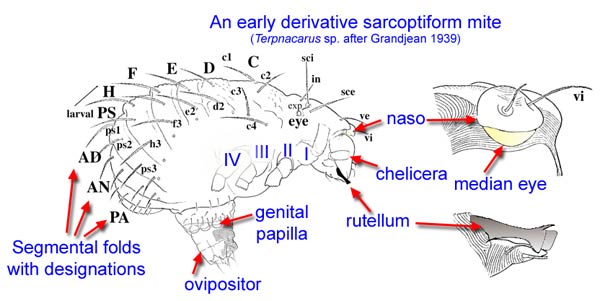
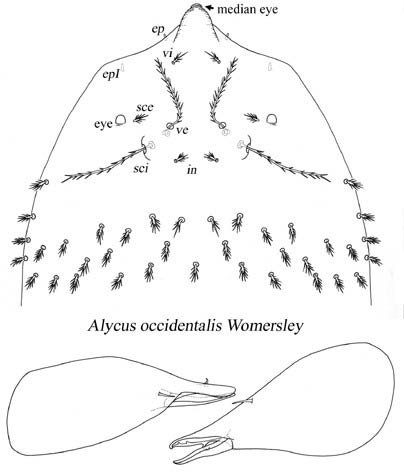
unsclerotized, usually with 5–6 pairs of setae (Vertex-scapular system: vi, ve, sci, sce, in, exp; also, Rostral-bothridial system, respectively: ro, le, bo, exa, in, exp) and, except in the usually worm-likeworm-like:
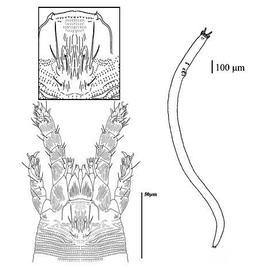
elongate, with reduced legs as in some Nematalycidae (Endeostigmata).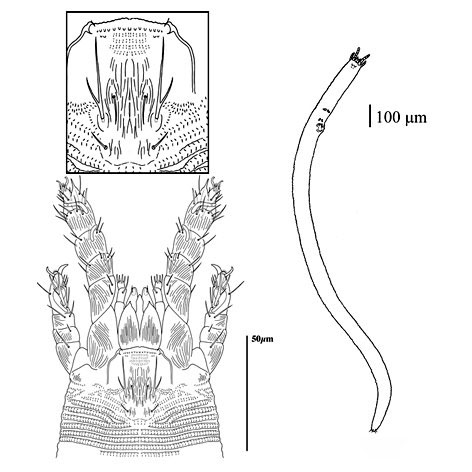 Nematalycidae, prodorsal setae sci (and sometimes sce) formed as trichobothriatrichobothrium:
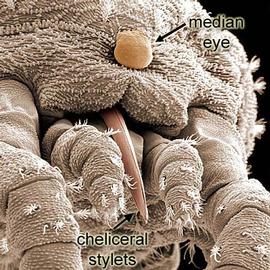
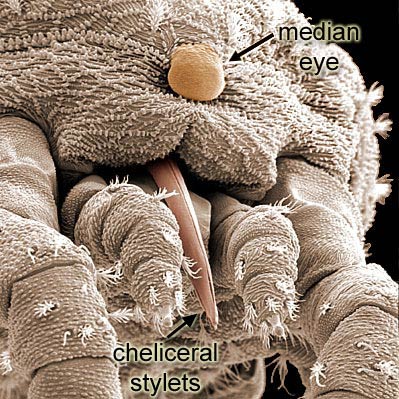
(pl. trichobothria) (= bothridial sensillum) an often elaborately modified seta set in a cup-like base; forms include filiform, ciliate, pectinate or variously thickened or clubbed (bat-like to globose or capitate).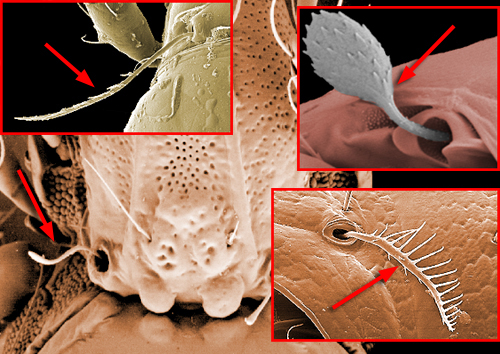 ; dorso-sejugal furrow distinct; naso and/or median eye often present; lens-like lateral ocellusocellus:
(pl. ocelli) a simple eye. Mites with eyes usually have one or two pairs of lateral ocelli, but some Opilioacarida have three pairs. Additionally, some acariform mites have one or two median ocelli on the underside of the naso.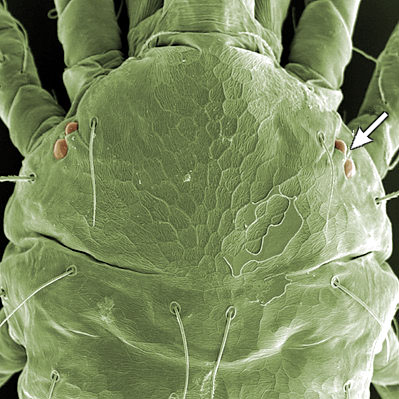 and post-ocular bodybody:
the idiosoma of mites. often present. Subcapitulumsubcapitulum:
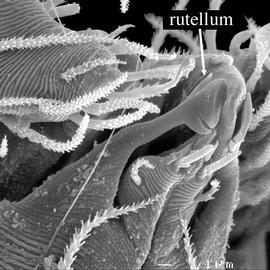
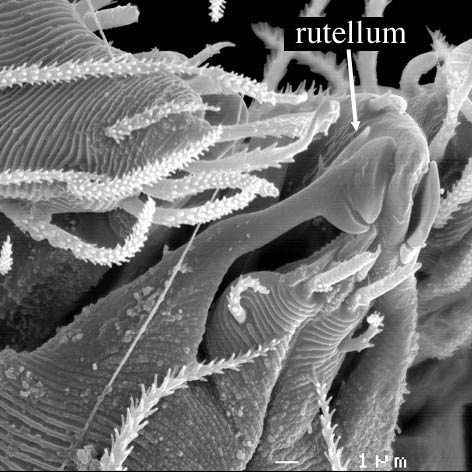
(also infracapitulum) the venter of the capitulum; the ventral faces of the fused palpcoxae; apparently formed independently in the two superorders of mites.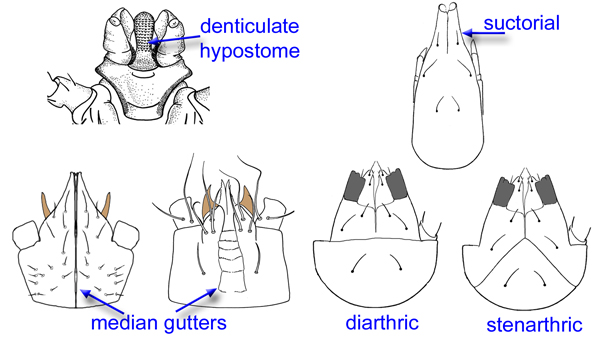 with lateral lips bearing 0–3 pairs of adoral setae, narrow rutellarutellum:
(pl. rutella) In Sarcoptiformes, the hypertrophied setae on the hypostome, often toothed; not to be confused with a corniculus (although possibly a homologue). In Astigmata, the rutellum may be referred to as a pseudorutellum, although it is the same structure. Various forms of rutella are recognized, including the atelebasic and pantelebasic.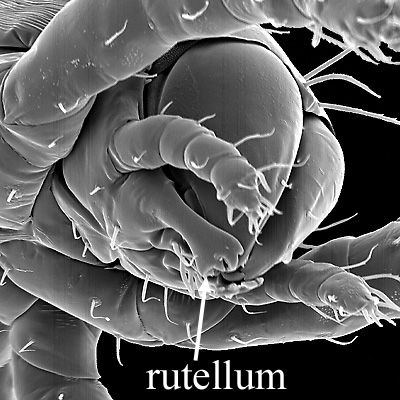 with distaldistal:
towards the free end of an appendage.
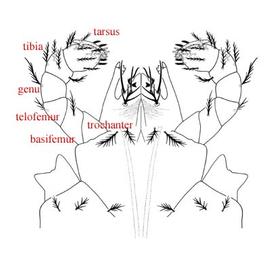
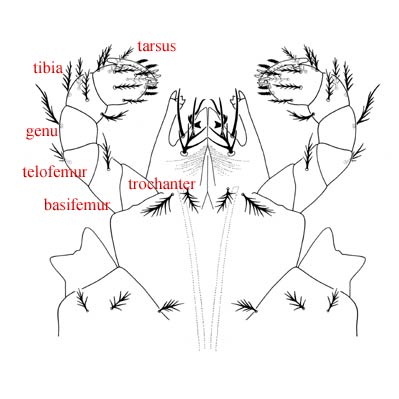
blade or teeth; 2–3 or more pairs of setae in the genal area; and usually a pair of peg-like epicoxal setae (ep); palps usually with 5 free segments (sometimes with femora subdivided) and without a palptibial clawpalptibial claw:
a claw-like seta on the palptibia of some Prostigmata that forms a chelate structure with the palp tarsus, the palp thumbclaw complex.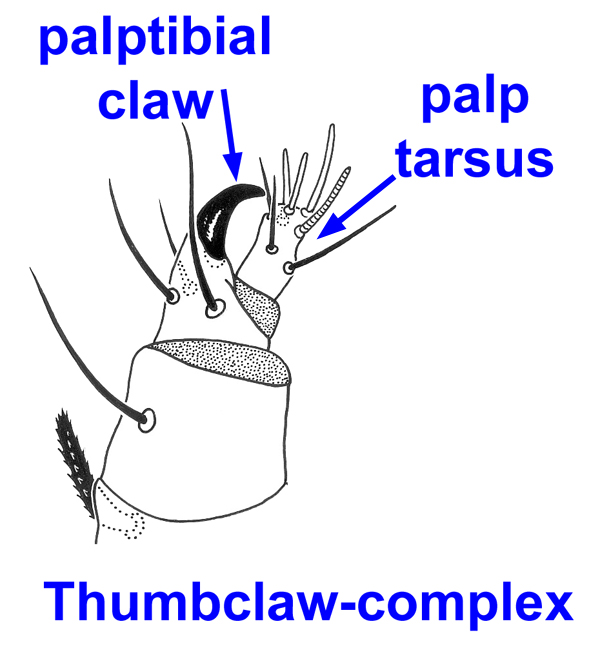 . Chelicerae often distinctly 3-segmented (trochantertrochanter:
the leg segment between the coxa and the femur.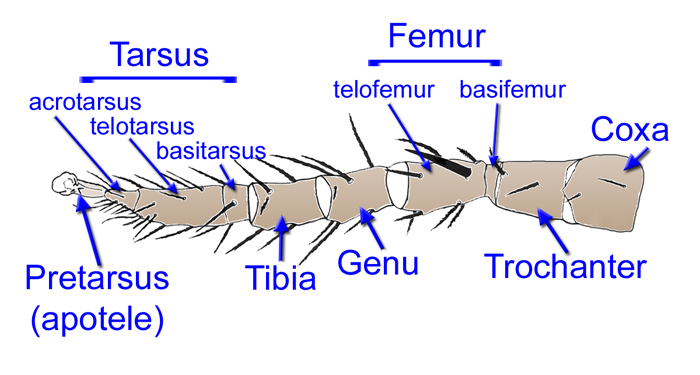 well developed), chelate-dentatechelate-dentate:
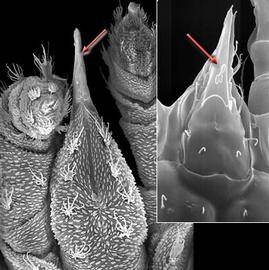
pincer-like chelicerae with teeth.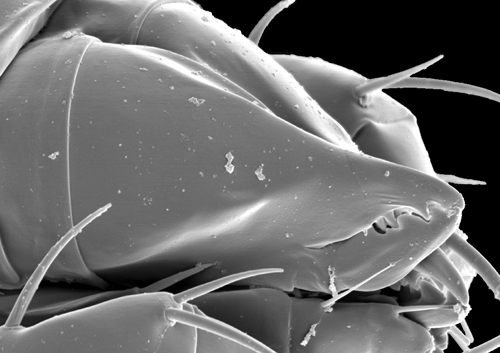 to attenuate-edentate stylets and bearing 0–2 setae; subcapitulumsubcapitulum:
(also infracapitulum) the venter of the capitulum; the ventral faces of the fused palpcoxae; apparently formed independently in the two superorders of mites. sometimes suctorial. Genital shields unsclerotized, bearing numerous genital setae, and covering 3 (rarely 2) pairs genital papillaegenital papillae:
1-3 pairs of extrusible finger-like to button-like projections, usually retracted into in the genital vestibule of acariform mites; sometimes formed as sessile disks around the genital opening; thought to be osmoregulatory structures; modified or multiplied and dispersed over the body in many freshwater mites. Genital papillae are absent in the larva, but may be added ontogenetically: protonymphs have one pair, deutonymphs two pairs, and tritonymphs (and adults) three pairs. The tritonymphal pair of papillae is often lost. The serially homologous Claparède's organ is usually present in the larvae (and prelarvae) of mites exhibiting genital papillae in nymphs and adults (Oudeman's Rule).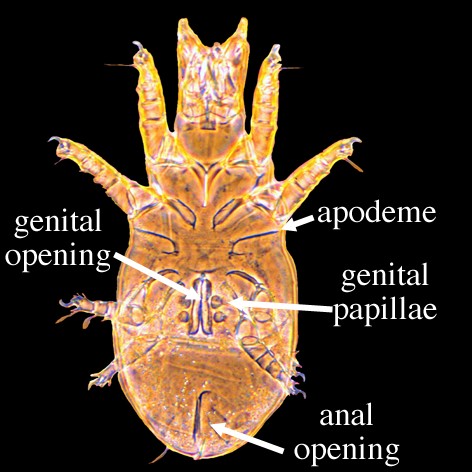 in the adult. Legs well supplied with solenidiasolenidion:
(pl. solenidia) a hollow, optically inactive chemosensory seta on the limbs of acariform mites appearing to have transverse rows of minute pores (actually pore canals) under light microscopy, (the transverse pattern is often not apparent in SEM); often bulbous or otherwise modified; sometimes associated with a companion seta. Solenidia are designated with Greek letters by leg segment: Ω (omega) on the tarsus, Φ (phi) on the tibia, and Σ (sigma) on the genu.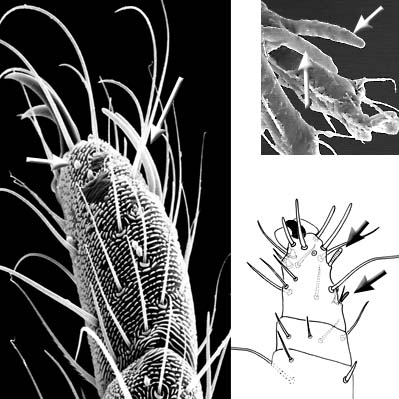 and other setae, but without trichobothriatrichobothrium:
(pl. trichobothria) (= bothridial sensillum) an often elaborately modified seta set in a cup-like base; forms include filiform, ciliate, pectinate or variously thickened or clubbed (bat-like to globose or capitate).; epicoxal setaepicoxal seta:
a minute, usually peg-like seta on the dorsal face of the palpcoxa (ep) or coxae of legs I (ep1) in some acariform mites.
epI sometimes present; pretarsi usually with empodiumempodium:
(pl. empodia) an unpaired structure arising between the tarsal claws, ranging from pad-like to claw-like and often bearing structures such as tenent hairs, dense setulae, or taking the form of a featherclaw (Eriophyoidea)..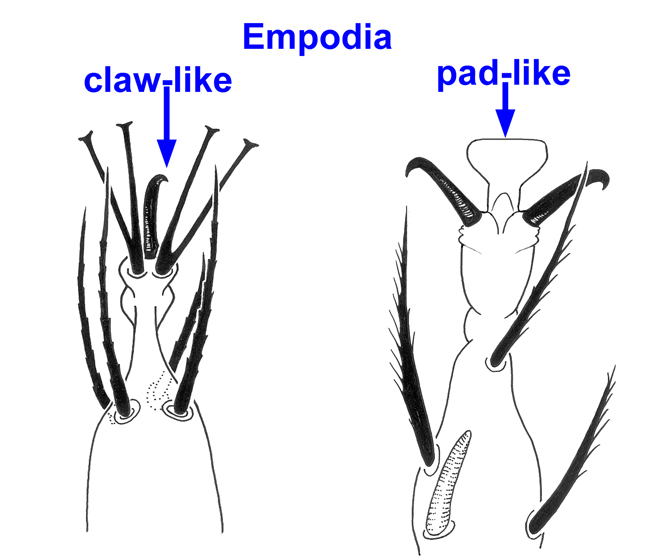 and often with claws; legs IV often modified for jumping.
Key to Endeostigmata and Sphaerolichida
Endeostigmata and Sphaerolichida fact sheet index
Some endeostigmatans resemble small, soft-bodied prostigmatans (especially members of the Eupodina), but usually have rutella and 6 rather than 3–5 prodorsal setaeseta:
(pl. setae, from L. = bristle) cuticular process composed of a hollow shaft (sometimes filled with a refractive material) produced from a membranous socket (the alveolus); the hair-like, spine-like, branched or variously expanded structures on the surfaces of the legs and body. Most setae function as mechanoreceptors, but others (e.g., solenidia) are chemoreceptors or have unknown or ambiguous functions.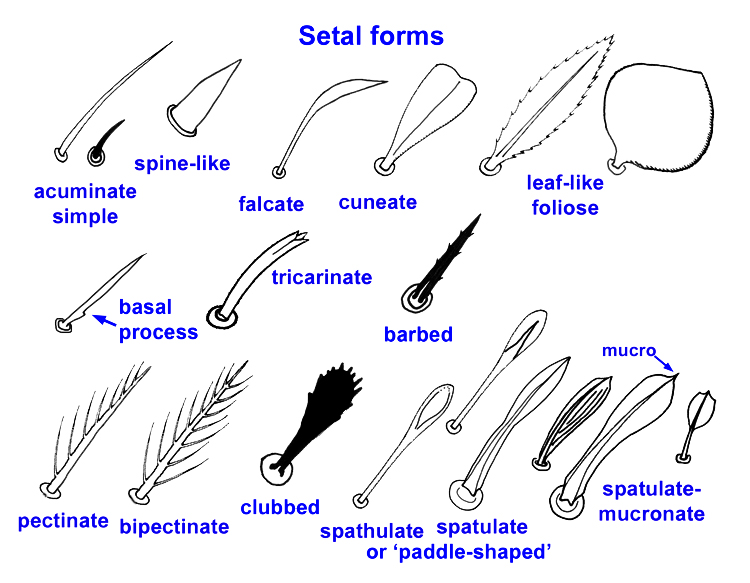 . Species of Nanorchestidae (Speleorchestes, Nanorchestes) are especially common in very dry habitats (sand dunes, hot desert soils, cold deserts) and can be distinguished by their 2 pairs of prodorsal trichobothriatrichobothrium:
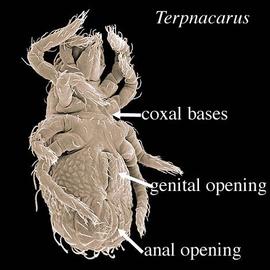
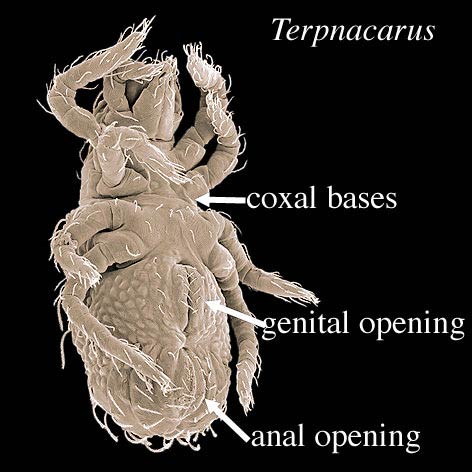
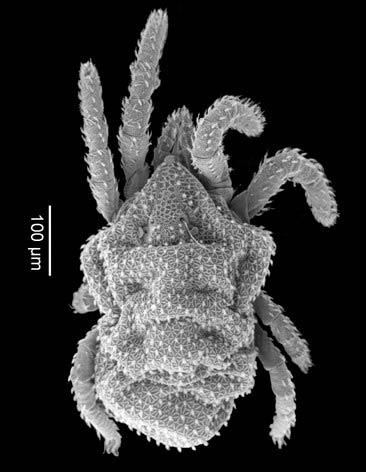
(pl. trichobothria) (= bothridial sensillum) an often elaborately modified seta set in a cup-like base; forms include filiform, ciliate, pectinate or variously thickened or clubbed (bat-like to globose or capitate). and heavily sclerotized, finger-like labrum. Members of the Terpnacaridae resemble soft-bodied oribatid mites.
Endeostigmatans are mostly tiny, globular or bizarrely elongate sarcoptiform mites that bear numerous primitive morphological characters. They are often found in extreme soil habitats (e.g., cold and hot deserts, microbial crusts, seashores, sandy soils, deep soil). Fossil endeostigmatans have been described from some of the earliest terrestrial faunas known, and their life styles tend to reflect their early derivation. For example, most endeostigmatans have the fundamentalfundamental:
(as in fundamental chaetome) a seta or other structure present in the larval stage.
acariform ontogeny, i.e., an egg, an inactive hexapod prelarvaprelarva:
(also deutovum, prolarva) the first instar in acariform mites having a complete ontogenetic sequence, but absent in derived Prostigmata and Parasitiformes (except Opilioacarida); incompletely formed, without functional mouthparts, often retained within the egg shell or just extruding from it, and usually inactive; hexapod or apodous.
, an active hexapodhexapod:
with three pairs of legs (i.e. 6 legs), as in the larvae of mites or the larviform stages of others.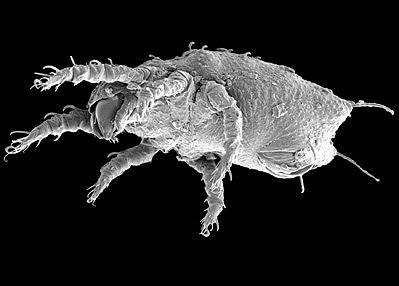 larva, and active octopod protonymphprotonymph:
the first nymphal stage or instar, usually octopod.
, deutonymphdeutonymph:
(also deuteronymph) the second nymphal stage or instar.
, tritonymphtritonymph:
the third, and final, nymphal stage or instar present in Opilioacarida, Holothyrida, Argasidae, and many Acariformes.
and adult. In some taxa the prelarvaprelarva:
(also deutovum, prolarva) the first instar in acariform mites having a complete ontogenetic sequence, but absent in derived Prostigmata and Parasitiformes (except Opilioacarida); incompletely formed, without functional mouthparts, often retained within the egg shell or just extruding from it, and usually inactive; hexapod or apodous.
is retained within the egg; but in others it expands, pops the egg shell, and then remains quiescentquiescent:
at rest, usually referring to an inactive developmental stage, e.g., the inactive immatures of acariform mites during the intermolt period.
. In some Nanorchestidae the prelarvaprelarva:
(also deutovum, prolarva) the first instar in acariform mites having a complete ontogenetic sequence, but absent in derived Prostigmata and Parasitiformes (except Opilioacarida); incompletely formed, without functional mouthparts, often retained within the egg shell or just extruding from it, and usually inactive; hexapod or apodous.
is able to move, but not feed. The stagestage:
a distinct developmental form, e.g., the egg, larval, nymphal and adult stages. Since mite instars are usually morphologically distinct, they are also stages (and see stase). Some authors, however, insist that instar should be apolysis to apolysis and stage ecdysis to ecdysis. Since apolysis can be a discontinuous process and, in any case, is difficult to determine, in practice the difference between a stage and an instar is abstract and of importance only if you have a contentious referee.
between molts is quiescentquiescent:
at rest, usually referring to an inactive developmental stage, e.g., the inactive immatures of acariform mites during the intermolt period.
and unable to move. The number of eggs matured at one time by a female seems to vary with size: small species tend to mature a single egg and large species many. A short ovipositorovipositor:
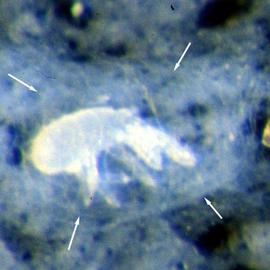
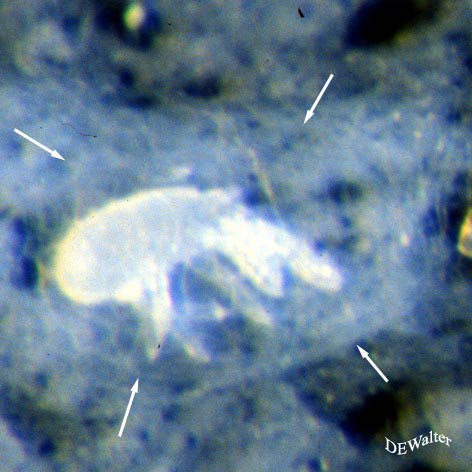
an extrusible organ for laying eggs. Female oribatids have a well developed ovipositor that ends in three finger-like projections. Ovipositors are less well developed or absent in other mites.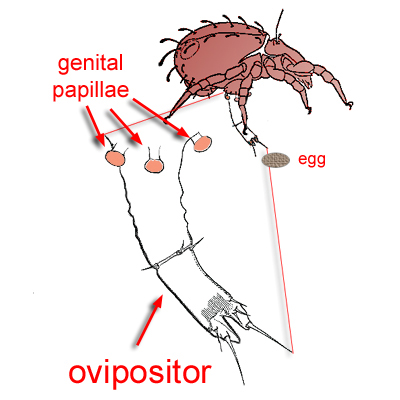 is primitively present, but has been lost in many groups. Males usually have a well developed spermatophoric organ for producing spermatophores, but all female parthenogenesis is common in the Terpnacarina and males are unknown for many taxa. In Alicorhagia, silken cocoons are spun for the deposition of eggs and before molts. Cocoons of other endeostigmatans can be found in soil extractions using flotation methods.
In the Terpnacarina and Alicorhagiina larvae and other active stages feed by ingesting pieces of solid food (i.e., particulate feeding) which form discrete gut boluses, a behavior shared with some Opiliones, opilioacarans and sarcoptiform mites. Within the Terpnacarina, fungi and sclerotized bits of small invertebrates can be identified in gut boluses. Outside of the Terpnacarina little is known about feeding biology. Some Bimichaeliidae (e.g., Alycus roseus Koch) appear to be exclusively predatory on nematodes, but others (e.g., Bimichaelia) have highly modified, elongate, needle-like digits that serve an unknown function. The Nanorchestidae are fluid-feeders and have a sclerotized tubular labium with an unknown function. Nanorchestes amphibius Topsent & Trouessart is reported to feed on green algae.
Author: David E. Walter
Content last updated Sept. 2006, unless indicated otherwise
Lucid key player updated Sept. 2025
idtools.org