t
Pachyseius Berlese
Superorder Parasitiformes » Order Mesostigmata » Suborder Monogynaspida » Infraorder Gamasina » Hyporder Dermanyssiae » Superfamily Eviphidoidea » Family Pachylaelapidae » Genus Pachyseius
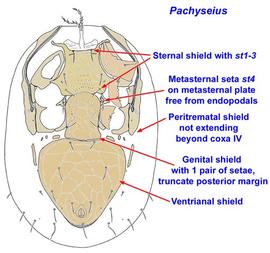
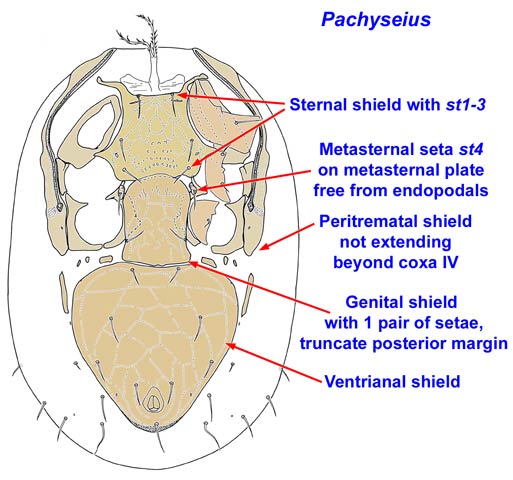
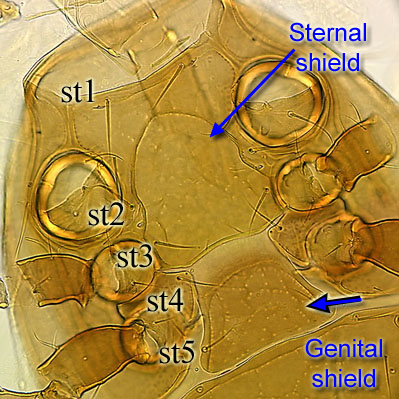 bearing 3 pairs of setaeseta:
 (st4 on small metasternal shield or in soft cuticle)
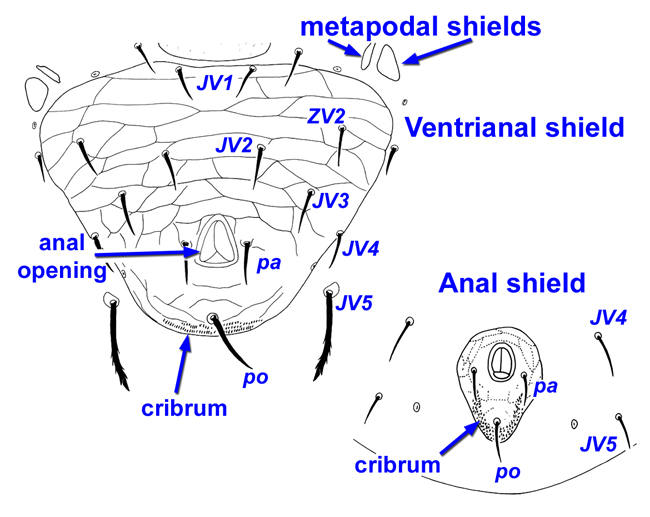 narrow to subcordate and with 7–10 setaeseta:
Species of Zygoseius lack spurs on tarsitarsus:
(pl. tarsi) the subdistal leg segment between the tibia and the pretarsus (apotele).
II and have st4 on metasternal-endopodal plates. Species of Macrocheles have recurvedrecurved:
a curved suture or line of dehiscence that arches posteriorly; opposed to procurved.
peritremes.
Females (and usually males) with spurspur:
a projection, usually tooth- or spine-like, from the body or limbs.
-like distaldistal:
towards the free end of an appendage.
setae on tarsustarsus:
(pl. tarsi) the subdistal leg segment between the tibia and the pretarsus (apotele).
II.............................. 3
- Spurspur:
a projection, usually tooth- or spine-like, from the body or limbs.
-like setae on tarsustarsus:
(pl. tarsi) the subdistal leg segment between the tibia and the pretarsus (apotele).
II absent.............................. 2
Female with subcordate ventrianal shieldventrianal shield:
in Mesostigmata, a ventral shield bearing the anal opening, circum anal setae, and one or more pairs of ventral setae or pores (lyrifissures) [see anal shield]; maybe rather narrow or very broad and covering most of the gaster. with 13 setae (ZV1–2, JV1–3 + circumanals); genital shieldgenital shield:
a shield or shields covering the genital opening; in female mongynaspine Mesostigmata this shield is usually called the epigynal (epigynial) shield.
truncate posteriorly and bearing 1 pair of setae; sternal shieldsternal shield:
a shield in the anterior intercoxal region of parasitiform mites that bears one or more pairs of sternal setae. with 3 pairs of setae and convex posteriorposterior:
the back part of the body or towards that region in comparison, e.g., 'posterior to'.
margin; metasternal setae on metasternal-endopodal shield; free-living or on dung beetles.............................. Zygoseius
- Female with anal shield (rarely capturing 1–2 ventral setaeventral setae:
in the Lindquist-Evans system used in the Mesostigmata, the ventral region has up to three longitudinal rows (Jv, Zv, Lv) with 1-5 transverse row designations.
); opisthogenital shield spreading laterally, with 2 pairs of setae and recurvedrecurved:
a curved suture or line of dehiscence that arches posteriorly; opposed to procurved.
posterior margin; associated with ants.............................. Sphaerolaelaps
Female sternal shieldsternal shield:
a shield in the anterior intercoxal region of parasitiform mites that bears one or more pairs of sternal setae. bearing 4 pairs of setae, opisthogenital shield with 2 or more pairs of setae, and anal shield with 3 circumanal setaecircumanal setae:
in Mesostigmata, the three setae (postanal and pair of peranal) setae surrounding the anal opening............................... 4
- Female sternal shieldsternal shield:
a shield in the anterior intercoxal region of parasitiform mites that bears one or more pairs of sternal setae. bearing 3 pairs of setae (st4 on small metasternal shield or in soft cuticle), genital shieldgenital shield:
a shield or shields covering the genital opening; in female mongynaspine Mesostigmata this shield is usually called the epigynal (epigynial) shield.
with 1 pair of seta, and ventrianal shieldventrianal shield:
in Mesostigmata, a ventral shield bearing the anal opening, circum anal setae, and one or more pairs of ventral setae or pores (lyrifissures) [see anal shield]; maybe rather narrow or very broad and covering most of the gaster. with 7–10 setae.............................. Pachyseius
Tibiatibia:
(pl. tibiae) the leg segment between the genu and the tarsus.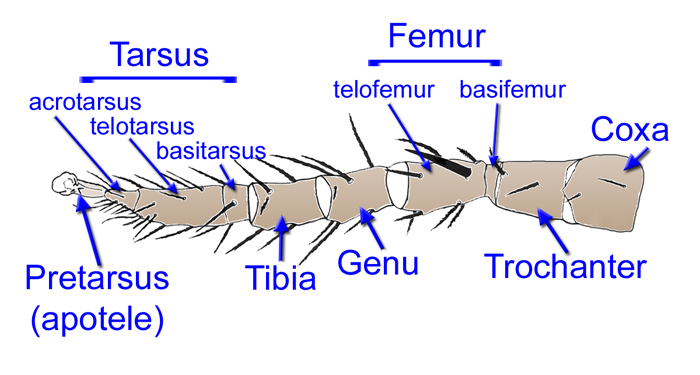 I with 5 dorsaldorsal:
relating to the upper or back side; opposed to ventral.
setae; palp apotelepalptarsal apotele:
(= palp apotele, palptarsal claw) the most distal segment of the palp; absent in Acariformes, claw-like in Opilioacarida, and a subdistal, tined structure in the Mesostigmata.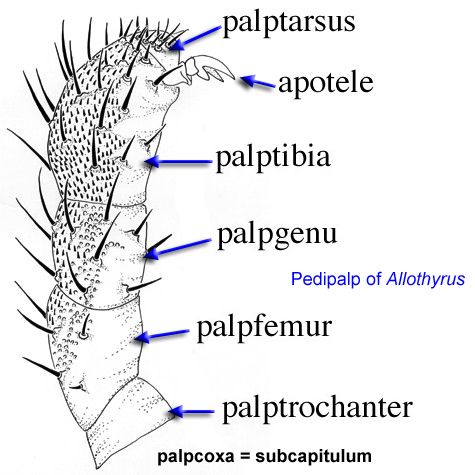 3-tined.............................. 5
- Tibiatibia:
(pl. tibiae) the leg segment between the genu and the tarsus. I with 6 dorsaldorsal:
relating to the upper or back side; opposed to ventral.
setae; palp apotelepalptarsal apotele:
(= palp apotele, palptarsal claw) the most distal segment of the palp; absent in Acariformes, claw-like in Opilioacarida, and a subdistal, tined structure in the Mesostigmata. 2-tined.............................. 6
Genugenu:
(pl. genua) (= patella) the 4th leg segment, between the femur and tibia.
I with 5 dorsaldorsal:
relating to the upper or back side; opposed to ventral.
setae.............................. Onchodellus
- Genugenu:
(pl. genua) (= patella) the 4th leg segment, between the femur and tibia.
I with 6 dorsaldorsal:
relating to the upper or back side; opposed to ventral.
setae.............................. Pachylaelaps
Seta st4 on small metasternal plate; dorsaldorsal:
relating to the upper or back side; opposed to ventral.
shield with 37 pairs of setae.............................. Pachyseiulus
- Seta st4 on in soft cuticle; dorsaldorsal:
relating to the upper or back side; opposed to ventral.
shield with 35 pairs of setae.............................. Pseudopachyseiulus
Author: David E. Walter
Content last updated Sept. 2006, unless indicated otherwise
Lucid key player updated Sept. 2025
idtools.org